

Introduction
Picture this: a quiet road after sunset, the kind where the evening air smells faintly of rain, motorbikes hum in the distance, and a row of streetlights flickers awake like fireflies with a job to do. Now imagine those lights don’t just shine. They clean themselves, save maintenance crews from endless ladder work, and use material made from agricultural leftovers that might otherwise be burned, dumped, or forgotten.
That’s where this curious, slightly futuristic idea steps into the spotlight. Self cleaning streetlight oil palm waste sounds like a mouthful, sure, but behind the phrase is a genuinely exciting thought: what if oil palm residue could help build public lighting that stays cleaner for longer?
It’s a neat “waste-to-worth” story. Oil palm processing produces residues such as empty fruit bunches, shells, fibers, fronds, trunks, and palm oil mill effluent, all of which create management challenges when they aren’t handled well. Researchers have studied these residues as useful biomass resources rather than plain rubbish.
And streetlights? Well, they’re everywhere. They’re silent workers, standing guard through dust storms, monsoon splashes, bird droppings, insects, traffic smoke, and the odd football kicked by a kid who swears it wasn’t him. Over time, dirt reduces brightness, solar panels lose efficiency, and cities spend money sending workers to clean and repair lights.
So, why not bring these two worlds together?
Why Streetlights Need a Greener Makeover
Streetlights are one of those public services people barely notice until they fail. When they work, roads feel safer, shops stay lively after dark, and pedestrians walk with a little more confidence. When they don’t, everyone complains—and honestly, they’re right to.
But keeping streetlights clean and efficient isn’t as simple as changing a bulb. Modern lights often include solar panels, sensors, batteries, LED lenses, aluminum housings, and control units. Dust and grime can dull the light lens. On solar-powered streetlights, dust buildup on photovoltaic panels can reduce energy yield, which is why automatic cleaning systems for solar panels have been studied as practical maintenance solutions.
The Hidden Cost of Dirty Streetlights
Dirty streetlights don’t make dramatic headlines. Nobody says, “Breaking news: lamp cover slightly cloudy!” Still, the problem sneaks up on cities.
A grimy light can mean:
- Lower brightness on roads and sidewalks
- More electricity or battery strain
- Shorter equipment life
- Higher maintenance costs
- More truck rolls, labor hours, and safety risks for workers
- Poorer visibility during rain, fog, or dusty weather
Standing under a dull streetlight, the road can feel oddly unsafe. It’s not total darkness, but it’s not comfort either. It’s that awkward middle ground where shadows stretch too long and potholes play hide-and-seek.
Why Oil Palm Waste Matters
Oil palm waste is often treated like the leftover crumbs of a large industry. Yet those “crumbs” are rich in fibers, carbon, cellulose, and lignocellulosic material. Empty fruit bunches, palm kernel shells, mesocarp fibers, and fronds can become useful ingredients in boards, biochar, paper, composites, fuels, and experimental materials.
Here’s the good bit: using agricultural residue in infrastructure could help reduce dependence on fully synthetic materials. It could also give farmers and processors another revenue stream. Instead of asking, “How do we get rid of this waste?” the better question is, “What can we build with it?”
That’s a different tune altogether.
How Self cleaning streetlight oil palm waste Could Work in Real Life
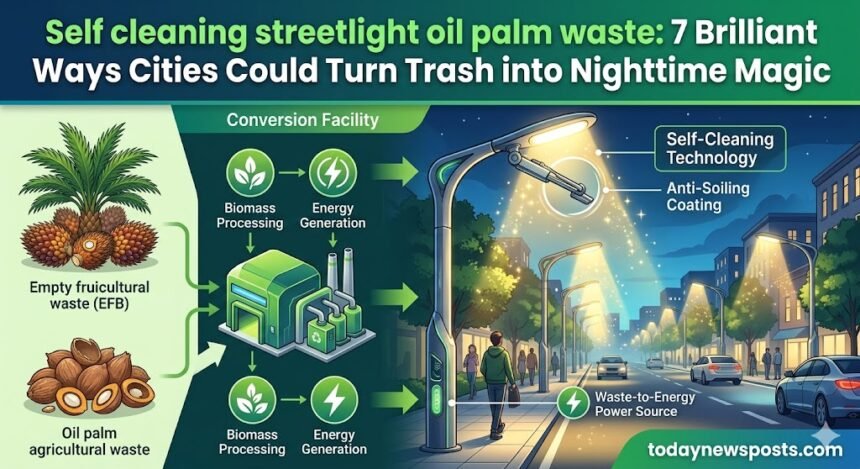
The idea doesn’t need to be pure sci-fi. It could combine three practical design paths: bio-based materials, self-cleaning surfaces, and smart solar lighting.
At its simplest, imagine a streetlight with a casing or panel frame made partly from oil palm fiber composite. The lens or solar panel surface could be treated with a self-cleaning coating. A tiny sensor could detect dust buildup. If the surface gets too dirty, a micro-wiper, vibration strip, air burst, or rain-assisted channel could help clean it.
Not too shabby, right?
Turning Waste into Functional Materials
Oil palm biomass contains natural fibers that can strengthen composite materials. In plain English, that means the fibers can be mixed with resins or binders to make parts that are lighter than metal and potentially less resource-heavy than conventional plastic.
Possible uses include:
- Lamp housing panels made with oil palm fiber composite
- Decorative poles or covers using treated biomass boards
- Cable protection sleeves made from bio-composite blends
- Internal support parts where heavy metal isn’t needed
- Sound-dampening or heat-buffering inserts made from processed fibers
Of course, nobody should just mash palm waste into a streetlight and call it innovation. The material would need proper treatment against moisture, mold, insects, cracking, and UV exposure. Cities need tough equipment, not pretty prototypes that fall apart after the first rainy season.
Adding a Self-Cleaning Surface
Self-cleaning surfaces usually work in one of two broad ways.
The first is water-shedding. Think of a lotus leaf. Water beads up, rolls away, and carries dust with it. A streetlight lens with a similar surface could stay clearer after rain.
The second is photocatalysis. In photocatalytic systems, light energy helps activate a catalyst, which can support reactions that break down certain pollutants on a surface. Open-access reviews describe photocatalysis as a field that uses photon energy to initiate chemical reactions through catalysts.
In a streetlight, this could mean a coating that helps break down grime when exposed to sunlight during the day. Then rain or dew could wash away the loosened dirt. No magic wand. No tiny cleaning fairy. Just chemistry, sunlight, and clever design doing their thing.
Dust, Rain, and Sunlight Working Together
Here’s the fun part: the environment that makes streetlights dirty could also help clean them.
- Sunlight activates certain surface coatings.
- Rainwater washes away loosened dust.
- Angled panel design helps water run off faster.
- Smooth lens surfaces reduce sticky dirt buildup.
- Sensors alert maintenance teams only when cleaning is truly needed.
Walking past the lamp after a storm, shining brighter than before, it’d feel like the city had quietly learned a new trick.
Possible Materials from Oil Palm Residue
Oil palm residue isn’t one single thing. It’s a family of materials, and each member has its own personality. Some are fibrous. Some are hard and shell-like. Some are better for carbon products. Others can be broken down into cellulose.
| Oil Palm Residue | Possible Streetlight Use | Key Advantage |
|---|---|---|
| Empty fruit bunch fiber | Composite casing, panel backing | Strong natural fiber source |
| Palm kernel shell | Biochar filler, carbon material | Hard, carbon-rich structure |
| Mesocarp fiber | Lightweight composite blend | Readily available mill residue |
| Palm frond cellulose | Coating support, molded parts | Renewable fiber potential |
| Oil palm trunk fiber | Structural boards or inserts | Large biomass volume |
Empty Fruit Bunch Fiber
Empty fruit bunches are left after fruits are removed during oil extraction. They’re bulky, fibrous, and often viewed as residue. But with the right processing, those fibers can become reinforcement in composite panels.
For a streetlight, that could mean outer covers that are sturdy yet lighter. It could also mean modular parts that are easier to replace. Instead of tossing an entire housing, a city could swap one damaged bio-composite panel. Easy as pie—well, after the engineering is done.
Palm Kernel Shell Biochar
Palm kernel shells are harder and denser. When converted into biochar, they may serve as fillers or carbon-rich materials in certain composites. Biochar can also improve material texture, stiffness, or thermal behavior depending on how it’s made and blended.
Imagine a dark, sleek streetlight casing that quietly contains carbon material made from former agricultural waste. It doesn’t shout, “Look at me!” It just does the job.
Palm Frond Cellulose
Palm fronds are pruned regularly in plantations, which means they’re abundant. Their cellulose can be explored for lightweight material applications. In a more advanced version, processed cellulose might help form films, coatings, or surface layers.
That’s the beauty of it. The frond that once waved in the tropical sun could someday help a city lamp survive that same sun.
Benefits for Cities and Villages
A good invention isn’t only clever. It has to solve problems for real people. This idea could support cities, small towns, rural roads, plantation communities, and industrial zones.
Lower Maintenance Costs
Self-cleaning features could reduce the number of manual cleaning trips. That means fewer trucks, fewer road closures, fewer workers climbing poles, and less fuel burned during maintenance runs.
For solar streetlights, this matters even more. A dusty solar panel can underperform, especially in dry or polluted areas. A cleaning-friendly design helps the battery charge more reliably, which keeps the light on when people need it most.
Cleaner Public Spaces
Bright, clean lighting changes how a place feels. A market lane looks warmer. A bus stop feels less lonely. A school road becomes easier to walk after evening tuition. It’s not just about technology; it’s about daily life.
Better lighting can support:
- Safer walking routes
- Clearer road edges
- More welcoming parks
- Better visibility near shops
- Reduced fear in poorly lit areas
Light, when done well, is public kindness on a pole.
New Income Streams for Farmers
Now, here’s where the story gets even better. If oil palm residues gain value as industrial inputs, local growers and processors could benefit. Waste collection, drying, sorting, fiber extraction, and pre-processing could create small businesses around the supply chain.
Instead of waste sitting in heaps, it could move into workshops. Instead of one industry’s leftover problem, it becomes another industry’s raw material. That’s circular economy thinking, and yep, it’s got legs.
Design Features of a Smart Green Streetlight
Let’s imagine the finished product. Not as a cold engineering diagram, but as a streetlight you might actually see on a road.
It stands tall with a matte bio-composite housing. Its solar panel sits at a careful angle, so dust doesn’t lounge around like it owns the place. The LED lens has a coating that resists grime. A narrow rain channel guides water across the lens. A tiny sensor checks surface clarity. When dirt gets stubborn, a small cleaning strip glides across the panel.
Nothing flashy. Nothing ridiculous. Just practical, graceful design.
Solar Panel with Dust Control
A solar-powered version would need special attention because its panel is its lifeline. If the panel gets dusty, the battery suffers. If the battery suffers, the lamp dims. And if the lamp dims, people notice.
A smart dust-control system might include:
- A sloped glass panel
- A hydrophobic coating
- A low-energy wiper
- A vibration pulse system
- A dust sensor linked to a maintenance app
The trick is balance. A cleaning system that uses too much energy defeats the purpose. The best design would clean only when needed.
Bio-Composite Housing
The lamp’s body could use oil palm fiber composite in non-critical sections. For safety, parts that carry heavy loads or face extreme heat may still need metal. But covers, trims, internal panels, and protective shells could include treated biomass-based materials.
That’s how green design usually grows—not by replacing everything overnight, but by swapping smarter parts where it makes sense.
Sensor-Based Cleaning Alerts
Sensors could measure light output, solar charging performance, humidity, and dust levels. When something drops below a set point, the system sends an alert. Maintenance teams wouldn’t need to guess which poles need attention.
Instead of cleaning every streetlight on a rigid schedule, crews could clean the few that actually need help. That saves time, and let’s be honest, nobody enjoys cleaning things that are already clean.
Challenges and Honest Limitations
Every bright idea has a shadow. Pretending otherwise would be silly.
The biggest challenge is durability. Outdoor lighting faces heat, cold, rain, insects, dust, wind, road vibration, and sometimes vandalism. Bio-composites must be tested for swelling, cracking, fire resistance, and long-term strength.
Self-cleaning coatings also wear down. A coating that works beautifully in a lab may struggle on a busy road beside diesel smoke, sea salt, or sticky industrial dust. Engineers would need field trials in different climates.
Durability and Weather Testing
Before any city installs these streetlights widely, the materials should pass tests such as:
- UV aging
- Rain and humidity exposure
- Salt spray resistance
- Heat cycling
- Dust abrasion
- Impact testing
- Electrical safety checks
- Fire performance testing
Skipping these tests would be asking for trouble. And trouble, as they say, doesn’t need an invitation.
Scaling Production
Another issue is consistency. Agricultural waste varies by location, season, processing method, and moisture level. To make reliable streetlight parts, manufacturers need steady quality. That means standards, sorting systems, drying methods, and supply agreements.
Still, these are not impossible barriers. They’re engineering homework. Hard homework, yes, but not the kind that makes you throw the notebook across the room.
Future Opportunities
The future of public lighting is bigger than bulbs on poles. Streetlights are becoming data points, safety tools, charging stations, environmental sensors, and design features. Add biomass-based materials and self-cleaning surfaces, and suddenly the humble streetlight becomes a symbol of cleaner infrastructure.
Smart Roads and Eco-Cities
In eco-cities, streetlights could do more than shine. They could monitor air quality, guide emergency vehicles, charge small devices, support public Wi-Fi, and reduce energy waste. A greener material base would make the whole system feel more complete.
Imagine a coastal town using palm-waste composites in public lights. Imagine plantation roads lit by lamps partly made from the same crops grown nearby. Imagine maintenance crews getting alerts before lights fail. That’s not just convenient; it’s beautifully local.
Circular Economy Innovation
Circular economy design asks us to keep materials useful for as long as possible. Oil palm waste becomes feedstock. Feedstock becomes parts. Parts become repairable systems. At the end of life, components are separated, recycled, or safely processed.
No system is perfectly circular, of course. But better loops beat broken lines.
And that’s the heart of this idea: waste shouldn’t be the end of the story. Sometimes, with the right spark, it becomes the opening chapter.
FAQs
What is the main idea behind this kind of streetlight?
The main idea is to combine self-cleaning lighting technology with materials made from oil palm residue. The streetlight could stay cleaner for longer while using agricultural by-products in selected parts.
Can oil palm waste really be used in streetlight materials?
Yes, potentially. Oil palm fibers, shells, and fronds can be processed into composite fillers, boards, cellulose materials, or carbon-rich products. However, they must be properly treated and tested before being used outdoors.
How would the streetlight clean itself?
It could use a mix of self-cleaning coatings, sloped surfaces, rainwater channels, low-energy wipers, vibration systems, or dust sensors. The best design would depend on local weather and dust conditions.
Would these lights work better in cities or rural areas?
They could work in both. Cities may benefit from lower maintenance costs, while rural and plantation areas may benefit from local material supply and off-grid solar lighting.
Are self-cleaning coatings permanent?
Usually, no. Coatings can wear down over time because of dust, weather, cleaning friction, and sunlight exposure. A real product would need maintenance planning and replacement schedules.
Is this technology available everywhere right now?
Not as a common finished product in this exact form. Parts of the idea already exist, such as solar streetlights, automatic panel cleaning systems, and biomass composites. The exciting part is combining them into one practical design.
Could this reduce environmental pollution?
It could help, especially if it reduces waste burning, lowers maintenance trips, and replaces some petroleum-based materials. Still, the full environmental benefit would need life-cycle testing.
Would it be expensive to build?
Early versions might cost more because of research, testing, and small-scale production. Over time, costs could drop if local biomass supply chains and manufacturing methods become efficient.
Conclusion
A streetlight may seem ordinary, but ordinary things often carry extraordinary possibilities. With the right design, a lamp on a roadside can become more than metal, glass, and electricity. It can become a small act of repair.
Oil palm waste, once treated as a stubborn leftover, could help shape cleaner public infrastructure. Self-cleaning surfaces could reduce maintenance. Solar panels could stay brighter. Farmers could gain new value from residues. Cities could save time, energy, and money.
Is the idea perfect today? Not yet. It needs testing, standards, prototypes, and honest field trials. But the direction is promising. It asks a better question about waste, public lighting, and sustainability: why throw away what could help us see?
And there it is—the humble streetlight, standing in the dark, quietly proving that even waste can have a second glow.