

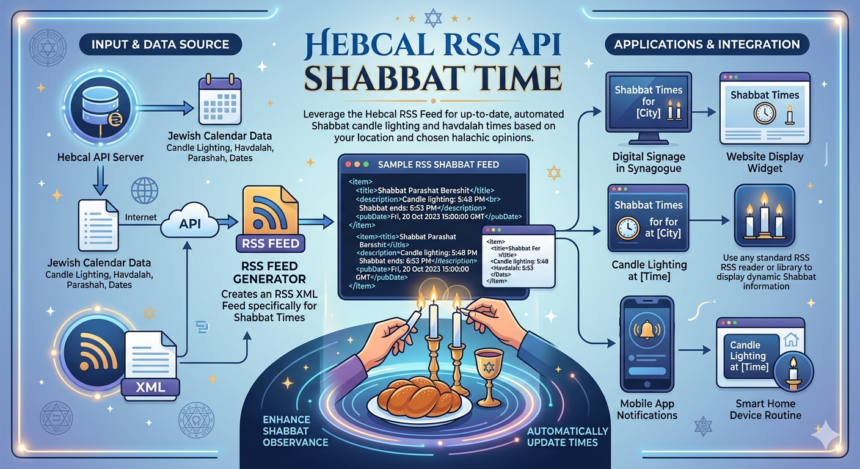
The digital age has changed how we observe ancient traditions. For developers and community leaders, providing accurate religious timings is no longer just about printing a calendar; it is about real-time accuracy and seamless integration. One of the most robust tools available for this purpose is the Hebcal RSS API.
The beauty of the Hebcal system lies in its simplicity and its depth. It provides a bridge between complex astronomical calculations and the end-user. Using the RSS (Really Simple Syndication) format, it allows for a “set it and forget it” approach to data distribution. In this guide, we will explore how to implement this tool effectively, ensuring your platform remains a reliable source for the community.
Understanding Hebcal API Basics
Before diving into the code, you must understand what makes the Hebcal RSS API unique. It is a RESTful service that returns Jewish calendar data in a structured XML format. Unlike static CSV files, the RSS feed is dynamic. It updates based on the parameters you provide in the URL. This means you can request data for specific cities, zip codes, or even latitude and longitude coordinates.
Core Features of RSS
- Dynamic Updates: Feeds refresh automatically without manual file uploads.
- Standardised XML: Compatible with almost every modern programming language.
- Customisable Parameters: Filter for specific events like candle lighting or Havdalah.
Geolocation and Time Accuracy
Accuracy is the most critical factor when dealing with religious timings. A two-minute error can be the difference between starting the Sabbath on time or inadvertently violating its sanctity. The Hebcal RSS API solves this by using a comprehensive database of global locations. When you query the API, you can specify a location ID or a ZIP code.
How Location Impacts Data
The system calculates the sun’s position relative to the horizon at your specific coordinates. It accounts for the earth’s tilt and seasonal shifts. This is particularly useful for users in extreme latitudes where sunset times change rapidly throughout the year. By pulling this data through an RSS feed, your application stays updated without requiring manual intervention every Friday morning.
Implementing RSS Feed Integration
Integrating the feed is straightforward for most modern web environments. Since RSS is essentially XML, you can parse it using JavaScript, PHP, or Python. Most Content Management Systems like WordPress have built-in widgets that can read an RSS URL and display the latest items as a list.
Customising Your Data Output
One size rarely fits all in web design. The Hebcal RSS API allows for significant customisation through URL parameters. You can decide whether to include the Hebrew date, the Parsha of the week, or special holiday information. For a minimalist sidebar widget, you might only want the candle lighting time for the current week.
Available Parameter Options
- cfg=r: Sets the output format to RSS.
- v=1: Ensures you are using the most stable version of the API.
- tgt=_blank: Ensures links in the feed open in a new tab.
Enhancing Local User Experience
The primary goal of providing Shabbat times is utility. To make your site better than a standard calendar, think about the user journey. A user visiting your site on a Friday afternoon is likely in a hurry. They need the information fast and in a format that is easy to read on a mobile device.
Design Tips for Users
Using the Hebcal RSS API ensures that the data is lightweight. Unlike heavy JavaScript plugins that can slow down page load times, a server-side RSS fetch is incredibly fast. This improves your site’s performance and accessibility. Providing a clear, high-contrast display of the timing can significantly improve the daily lives of your users.
Solving Common Technical Hurdles
Sometimes, developers run into issues with caching. If your server caches the RSS feed for too long, users might see last week’s times on a Friday morning. It is vital to set a reasonable cache expiry—perhaps six to twelve hours. This ensures the data is fresh while still reducing the number of hits to the Hebcal servers.
Common Troubleshooting Steps
- Check Time Zones: Ensure your server doesn’t overwrite the local city time.
- Validation: Use an RSS validator to ensure your URL parameters are correct.
- Fallbacks: Display a “Data loading…” message if the feed fetch fails.
Benefits of Automated Feeds
Manual data entry is the enemy of accuracy. In the past, webmasters had to manually type in times every week. This led to typos and outdated information. By moving to an automated system like the Hebcal RSS API, you eliminate human error.
Why Automation Wins
- Scalability: Manage dozens of locations with one template.
- Reliability: Times are calculated by experts, not entered by hand.
- Consistency: Your site stays relevant even when you are offline.
Future Proofing Your Website
Web standards evolve, but RSS has remained a stable and reliable protocol for decades. By basing your Shabbat timing features on the Hebcal RSS API, you are choosing a path that is unlikely to break with the next browser update. It is a sustainable choice for long-term projects.
Long-term Advantages
Furthermore, as voice assistants and smart home devices become more prevalent, having a clean data feed becomes even more valuable. You could potentially use this same RSS feed to power an Alexa skill or a Google Home routine that announces the candle lighting time to a family as they prepare for the evening.
Optimising for Search Visibility
From an SEO perspective, providing unique and helpful tools like a Shabbat timer can improve your rankings. Search engines value sites that provide specific, high-utility data. When you integrate the Hebcal RSS API, you aren’t just adding content; you are adding a functional tool.
Advanced Integration Scripting Tips
For those who want to go beyond a simple list, consider using a bit of CSS to style the feed items. You can highlight the “Candle Lighting” time in a bold box to make it the focal point of the page. You could even use a simple script to count down the hours and minutes until the Sabbath begins.
Enhancement Ideas
- Custom CSS: Match the feed style to your site’s branding.
- Countdown Timers: Show exactly how long is left until sunset.
- Interactive Maps: Let users click a map to update the feed location.
Maintaining High Editorial Standards
When writing about religious topics, the tone must be respectful and clear. Avoid jargon where a simple explanation will do. Instead of just listing a time, explain that this is the “latest time to light candles.” This helps people who may be new to the tradition or are visiting for a special occasion.
Summary of Implementation Steps
To get started, visit the Hebcal website and navigate to their API customisation page. Select your location and the specific events you want to track. Copy the generated RSS URL and bring it into your website’s backend.
Quick Start Guide
- Navigate to the Hebcal API generator.
- Choose your location (City or ZIP).
- Select “RSS” as the output format.
- Paste the URL into your site’s RSS reader or code.
Elevate Your Digital Presence
The integration of the Hebcal RSS API is more than a technical addition; it is a service to your community. It provides peace of mind to those looking to observe the Sabbath correctly. By following the steps outlined in this guide, you can create a resource that is both technologically advanced and deeply rooted in tradition.
In a world full of digital noise, providing specific, accurate, and timely information is the best way to stand out. Your commitment to quality data reflects your commitment to your audience. Start integrating these feeds today and see the difference it makes in your site’s utility and user satisfaction.
Final Thoughts on Accuracy
Providing accurate information is a responsibility. By using the Hebcal RSS API, you are utilising the most reliable data source available for Jewish timings. This ensures that your website remains a trusted pillar for the community, offering precision that manual methods simply cannot match. Take the time to set it up correctly, and your users will thank you every week.
Frequently Asked Questions
What is the Hebcal RSS API? It is a dynamic data feed providing Jewish calendar events and Shabbat timings in an XML format.
Is the RSS feed free to use for websites? Yes, Hebcal offers its API for free to most users, provided you follow their attribution guidelines.
How often does the Shabbat feed update? The feed is dynamic and updates automatically based on the current date and your specified location.
Can I use the API for any city worldwide? Yes, the API supports global coordinates, ZIP codes, and a vast database of international cities.
Does the API handle daylight savings time? Yes, the system automatically adjusts for local daylight savings changes based on the location provided.