
Introduction
Let’s be honest, recycling has a bit of an image problem. People want to do the right thing, sure, but half the time they’re standing over a bin wondering whether that coffee cup is recyclable, whether the lid goes somewhere else, or whether the whole thing is headed straight for landfill anyway. It’s messy. It’s confusing. And when confusion becomes routine, good intentions start slipping through the cracks.
That’s where Matarecycler starts to sound interesting.
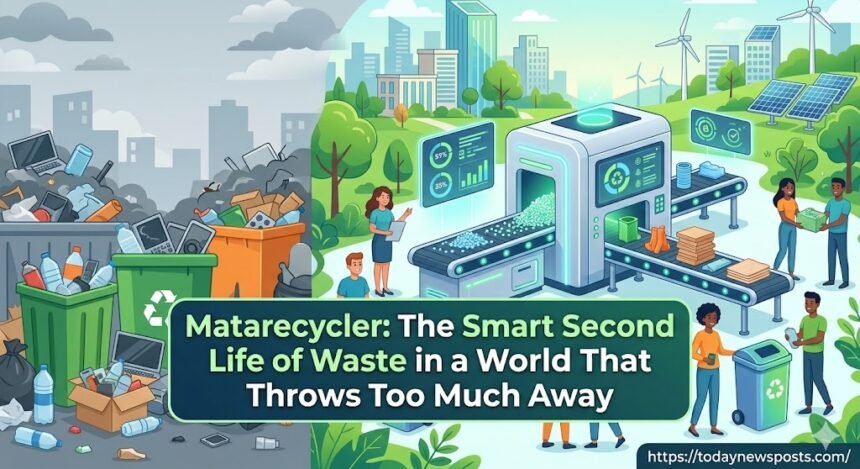
Recent web sources commonly describe Matarecycler as a smart or AI-assisted recycling platform or system designed to improve waste sorting, cut contamination, and make recycling easier for households, businesses, and even cities. Different write-ups vary in detail, but they generally present the term as part of a modern recycling solution built around automation, sensors, app-based support, or data-driven waste management.
And honestly? That idea couldn’t come at a better time.
We live in an age of overconsumption, overpackaging, and overpromising. Companies slap “eco-friendly” on almost anything, cities push recycling campaigns with mixed results, and ordinary people are left trying to sort the mess with little more than guesswork. No wonder so much recyclable material ends up spoiled by contamination or dumped where it never should have gone.
So, if Matarecycler represents a smarter way to deal with waste, it’s worth exploring. Not just as a piece of tech, but as a reflection of something bigger: the desperate need to stop treating trash like an afterthought.
What Is Matarecycler?
Based on recent articles, Matarecycler is most often described as an intelligent recycling system or platform that uses technology to improve the way waste is identified, sorted, tracked, or processed. Some sources emphasize AI-based sorting and material recognition, while others focus on app-connected recycling assistance and easier coordination with local waste services.
That may sound technical, but the basic idea is pretty simple.
Instead of relying entirely on people to guess where every item belongs, Matarecycler appears to shift more of the decision-making to technology. That means smarter detection, faster sorting, and fewer mistakes. And fewer mistakes matter a lot, because contamination is one of the biggest headaches in recycling. One greasy pizza box in the wrong place, one half-full drink container, one mixed-material item tossed carelessly into the bin, and suddenly a whole batch becomes harder to process.
That’s the tragedy of ordinary recycling. It’s full of effort, but not always full of accuracy.
So the appeal of Matarecycler lies in its promise to close that gap. It tries to make recycling less dependent on perfect user behavior and more supported by smart systems that can recognize, separate, and manage materials correctly.
That’s not just convenient. It’s practical.
Why Traditional Recycling Struggles So Much
Here’s the uncomfortable truth: traditional recycling often asks too much of ordinary people.
People are expected to know the difference between recyclable plastic types, understand local collection rules, rinse containers properly, separate materials, flatten cardboard, avoid contamination, and somehow keep up with changing municipal guidelines. That’s a lot! For something most people do between errands, school runs, work stress, and trying to remember where they left their keys, it’s frankly a big ask.
And when systems are complicated, people make mistakes. Not because they don’t care, but because life is busy.
This is where the concept behind Matarecycler feels refreshing. If the current system depends too heavily on perfect human sorting, then smart technology can help absorb some of that burden. According to recent descriptions, Matarecycler is meant to improve recycling outcomes by recognizing materials more accurately and reducing contamination before waste reaches later stages of processing.
That shift matters because contamination doesn’t just create small delays. It can reduce the usable value of recyclable material, increase labor needs, and send more waste to landfill than most people realize. A smarter front end can make the whole chain work better.
And that’s really the heart of the matter. Recycling isn’t only about bins. It’s about systems.
Matarecycler and the Rise of Smart Waste Sorting
Now we’re getting to the good bit.
One of the strongest themes in recent writing about Matarecycler is smart sorting. In these descriptions, the system is connected with AI, sensors, computer vision, or automated detection methods that help identify different materials like plastic, paper, metal, and glass, sometimes in real time.
That’s a big leap from the old model.
For years, recycling has relied on a messy blend of human effort and mechanical processing. Sometimes it works well enough. Sometimes it doesn’t. But the more complex packaging becomes, the harder it gets. Multi-layer materials, mixed plastics, coated paper, electronic waste, and oddball consumer items are not exactly simple to process.
So when a system like Matarecycler is described as using smarter detection, it hints at something more adaptive. Something capable of learning patterns, improving identification, and reducing the number of wrongly sorted items entering the stream.
That matters for three reasons:
- Better accuracy means more material stays usable.
- Lower contamination means less waste gets rejected.
- More efficiency can reduce costs and pressure on facilities.
It’s not magic, of course. No system is perfect. But smarter sorting is one of those ideas that feels both obvious and overdue. We’ve built technology to recognize faces, translate languages, and drive cars, yet we still struggle to sort bins properly. Go figure.
How Matarecycler Could Change Daily Life
Let’s bring this down to human scale.
A lot of sustainability talk sounds impressive but feels distant. It’s all “policy frameworks” and “circular economies” and “resource optimization.” Important? Yes. Exciting? Sometimes. Easy to feel in ordinary life? Not always.
But Matarecycler becomes more interesting when you imagine what it changes on an everyday level.
Picture this:
You throw something away, and instead of hoping you guessed correctly, the system helps identify what it is. Maybe it sorts the item automatically. Maybe it gives app-based guidance. Maybe it tracks your habits and offers feedback. Maybe it helps a building manager understand where contamination keeps happening. Maybe it helps a city spot which collection points are underperforming.
Suddenly recycling stops being a vague moral chore and becomes a clearer, smarter routine.
Recent descriptions of Matarecycler suggest exactly that kind of practical support, especially where app connectivity, local waste coordination, and data-driven recycling are involved.
And that’s key. Good environmental systems don’t just inspire people. They remove friction. They make the right action easier than the wrong one. That’s when habits actually change.
Matarecycler in Homes, Businesses, and Cities
One of the most promising things about the concept is that it doesn’t seem limited to one setting.
Recent sources present Matarecycler as suitable for individuals, businesses, organizations, and even smart-city style waste systems. In those descriptions, the technology supports not just personal recycling but broader waste-management efficiency across larger environments.
That range is important because waste problems are layered.
A household might struggle with confusion.
An office might struggle with consistency.
A city might struggle with scale.
A recycling facility might struggle with contamination.
Each level has different pain points, but they all connect.
So a smart recycling system becomes more valuable when it works across those layers. A home version may focus on user guidance. A workplace setup may focus on monitoring waste streams and improving employee compliance. A city-scale rollout may use data, automation, and route optimization to improve the whole network.
Now, does every city on earth suddenly become spotless because of smart bins? Obviously not. Let’s not get carried away. But a system that improves accuracy across multiple settings could produce compound benefits over time.
And in waste management, compounding matters. Small improvements repeated at scale can have a massive effect.
The Environmental Promise Behind Matarecycler
This is where the bigger picture comes in.
Recycling, when done properly, can help conserve resources, reduce landfill use, and lower environmental impact. Recent writing about Matarecycler specifically highlights benefits like reduced contamination, improved material recovery, lower landfill waste, and stronger support for sustainability goals.
That’s not just PR language. It points to a real bottleneck in current waste systems.
A huge part of the environmental problem is not only the amount of waste we produce, but the inefficiency with which we handle it afterward. Materials that should be reused are often spoiled. Valuable resources are mixed together carelessly. Facilities spend time and money correcting preventable errors. And meanwhile, the public is told to “recycle more” without always being given better tools.
That’s why the promise behind Matarecycler feels practical rather than dreamy. It isn’t pretending waste will disappear. It’s saying waste can be handled better.
And that’s a more useful ambition.
Because let’s face it, the modern world is not quitting packaging tomorrow. E-commerce isn’t vanishing. Consumer goods aren’t slowing down. So smarter post-consumption systems are absolutely necessary.
Technology Is Only Half the Story
Now, here’s an important caution.
Even if Matarecycler is as clever as recent sources suggest, technology alone won’t solve the waste crisis. That would be too easy, and life is rarely that generous.
A smart recycling platform can improve sorting, provide guidance, and reduce contamination. Great. But if producers keep making hard-to-recycle packaging, if policy stays weak, if infrastructure remains patchy, and if people treat bins like magical black holes where responsibility disappears, then progress will still be limited.
In other words, the tech matters, but the culture matters too.
The real value of Matarecycler may be that it helps bridge those two worlds. It brings smart tools into an area where public behavior and system design constantly collide. It can’t replace responsibility, but it can support it. It can’t create perfect sustainability, but it can make better decisions easier and bad habits harder to maintain.
That’s not nothing. In fact, that’s often exactly how real progress works.
What Makes Matarecycler Feel Timely?
Timing, oddly enough.
We’re living in a moment where people are more aware of environmental issues than ever, yet many still feel unsure about what actually helps. There’s climate anxiety, greenwashing fatigue, growing pressure on cities, and a rising demand for systems that are not just idealistic, but functional.
That’s where Matarecycler hits a nerve.
It sits at the intersection of three modern demands:
- people want sustainability to be easier
- cities want waste management to be smarter
- businesses want systems that are efficient and measurable
Recent coverage presents Matarecycler as part of exactly that shift toward intelligent, data-supported, user-friendly recycling systems.
And frankly, the timing couldn’t be more relevant. The old model of “just toss it in the blue bin and hope for the best” is wearing thin. People know it. Municipalities know it. Facilities definitely know it.
So a smarter approach doesn’t just sound trendy. It sounds necessary.
Challenges Matarecycler Would Still Need to Face
Let’s not romanticize it.
Any smart recycling system, Matarecycler included, would still face real-world hurdles:
1. Cost
Advanced systems with sensors, AI, automation, or app integration are not always cheap to deploy.
2. Infrastructure gaps
A smart tool still depends on collection networks, processing facilities, and local waste systems that can support it.
3. Public adoption
Even brilliant systems can fail if people don’t trust them, understand them, or use them consistently.
4. Complex materials
Some items are simply difficult to recycle, no matter how advanced the system gets.
5. Policy alignment
Technology works best when rules, incentives, and infrastructure support it rather than undermine it.
None of that means the idea is weak. It just means reality is stubborn. The waste problem is complicated because it’s tied to economics, habits, design, logistics, and politics all at once.
Still, a smarter system is a step forward. And sometimes, step-by-step progress is the only kind that lasts.
Why Matarecycler Matters Beyond Recycling
Here’s the deeper reason the term is compelling.
Matarecycler is not only about bins, sensors, or waste streams. It represents a broader shift in thinking. It suggests that environmental action shouldn’t rely purely on guilt or guesswork. It should be built into systems that help people do better without making everything harder.
That’s a powerful idea.
For years, sustainability messaging has often focused on personal blame. You should do more. You should sort better. You should consume differently. Fair enough, sometimes. But systems matter. Design matters. Tools matter. If the system is clumsy, even good people struggle to use it well.
So the appeal of Matarecycler is bigger than recycling itself. It hints at a future where environmental responsibility is supported by intelligence, feedback, and better infrastructure. Not perfect. Not effortless. But better designed.
And really, that’s what smart sustainability should be.
FAQs
What is Matarecycler?
Recent sources generally describe Matarecycler as a smart or AI-assisted recycling platform or system that improves waste sorting, reduces contamination, and supports more efficient recycling.
How does Matarecycler work?
Descriptions vary, but recent articles say Matarecycler may use app-based support, AI, sensors, automation, or material-recognition systems to identify and manage recyclable waste more accurately.
Why is Matarecycler different from normal recycling?
It is presented as a smarter system that reduces human error and contamination by helping identify and sort materials more effectively than traditional recycling methods.
Can Matarecycler help cities and businesses too?
Yes. Recent sources describe Matarecycler as useful not just for individuals but also for businesses, public spaces, and broader smart-city waste systems.
Does Matarecycler solve every waste problem?
No. Based on current descriptions, it appears to improve recycling efficiency and sustainability, but broader waste challenges still depend on infrastructure, policy, packaging design, and public behavior. This is an inference from the technology’s described role rather than a direct claim by one source.
Conclusion
In the end, Matarecycler feels important because it speaks to a problem people know all too well: waste is everywhere, and the systems we rely on to manage it often feel clunky, confusing, or outdated. A smarter recycling model won’t fix everything overnight, but it can make a real dent where it counts most, at the point where good intentions usually collide with bad systems.
That’s why the idea sticks.
It offers something practical. A way to reduce confusion. A way to improve sorting. A way to make recycling less about guesswork and more about intelligence. And in a world overflowing with waste, that’s not a small promise. It’s a necessary one.
So whether you see Matarecycler as a smart platform, an AI-powered recycling helper, or simply a better way to handle yesterday’s rubbish, one thing is clear: the future of waste management won’t just be greener. It will have to be smarter too.